Evidence: Five-quadrant haul model (USGS MCS 2026): Q1–Q3 base case $40M–$60M/yr stands without premium metals. Q4 upgraded ferrous compounds add $14M–$30M/yr conditional on magnetic interpretation. Q5 polymetallic anomaly is optionality. SBC 4.2 m/day bore rate validated (3× industry). Automated bore-return system improves gross value per lifted ton by rejecting waste before shaft handling. Hermes round-trip utilization model exploits Jones Act backhaul arbitrage: $40/t standard vs $<12/t via Hermes.
Implication: Capital thesis: ownership follows utilization — capital deploys only where utilization justifies ownership. Phase I CAPEX $276M base designed to stand without premium metal hit. Federal target ~$1.7B de-risks Phase I across DOE ASCR/Geothermal, DOD/DOE Critical Minerals, EDA Build to Scale, MARAD, NSF Engines. Bond issuance at Year 3 ($4M Sr + $2M ZC + $2M Rev) unlocks debt-heavy scaling only after Gate 4 (≥3 LOIs/MOUs by Month 4/Day 60). Byproduct margins pilot-validated: Fe catalysts 45%, Gypsum 55%, LiFePO₄ 42%, Silica Gel 38%.
Boundary: Research program — no operating facility, no secured funding, no regulatory approval. Funding is restricted to non-dilutive capital. Q4/Q5 are magnetic-interpretation split of same anomaly; not a reserve statement. Technical specifications proprietary — available under NDA to qualified capital partners.
Capital Lens
Moat: Thermodynamic integration (infinite heat sink, zero surface footprint, internalized power). SBC 4.2 m/day bore rate (3× industry). Automated bore-return system rejects waste before shaft handling. Jones Act backhaul arbitrage via Hermes ($40/t→$<12/t). Six-entity cross-ownership with super-voting governance. Traction:
Traction: DOE Geothermal LOI submitted. PR Renewable Energy Initiative drafted. SBC 4.2 m/day validated. Super-voting locked. Phase I CAPEX defined. Upside:
Upside: Federal de-risks Phase I; Bonds unlock after Gate 4; Q5 anomaly provides optionality; byproduct margins pilot-validated (Fe catalysts 45%, Gypsum 55%, LiFePO₄ 42%, Silica Gel 38%).
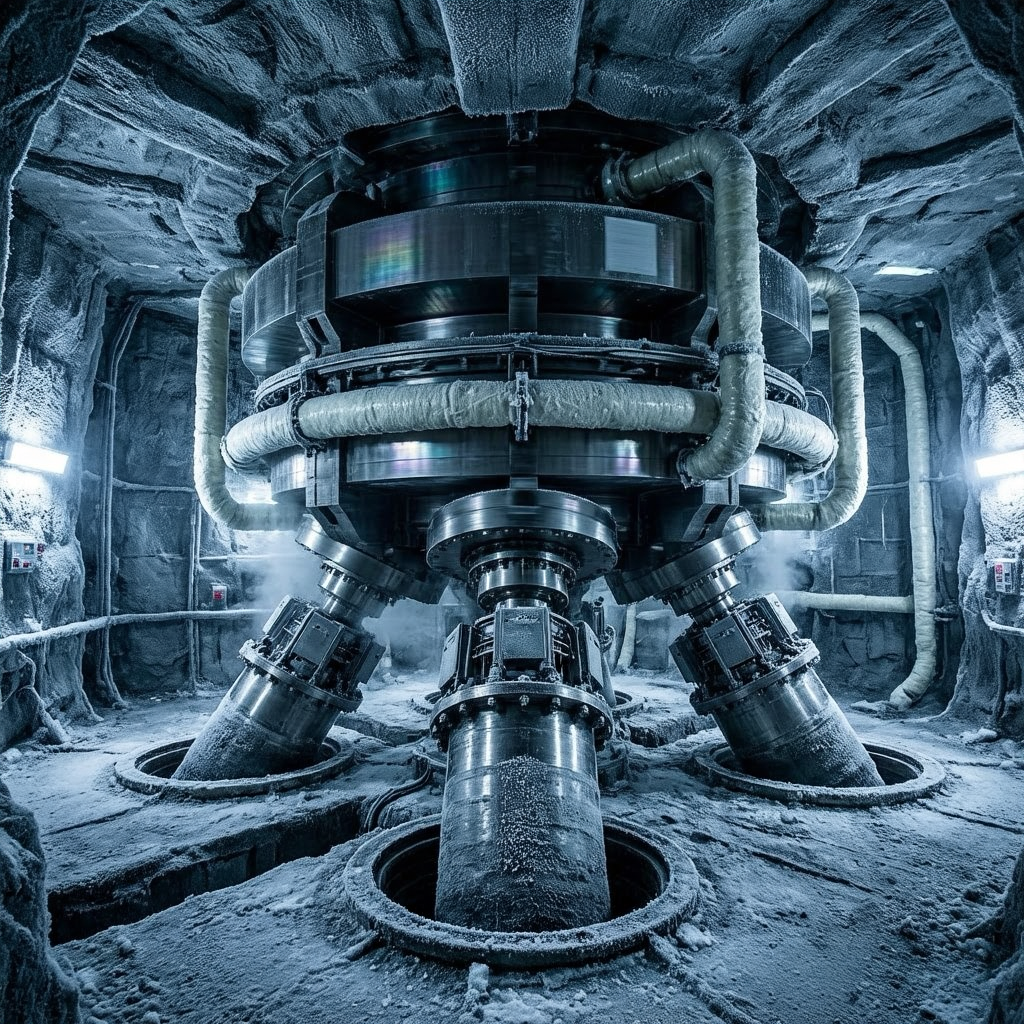
Excavation becomes a process stream
The working corpus starts with a six-metre autonomous shaft-boring concept and shallow diagonal access bores. Cuttings move by slurry, conveyor, or autonomous shuttle into a central preparation line. Crushing, screening, gravity separation, flotation, magnetic separation, centrifugation, and hydrocyclones produce characterized fractions before any chemical synthesis is selected.
The chemical matrix explores quartz and clay as silica/alumina feedstocks, calcite plus quartz for calcium silicates, iron oxides for iron-bearing products, and gypsum or sulfides as separate recovery streams. These are candidate pathways. XRF, assay, mass balance, energy balance, reagent recovery, and pilot yields must decide which pathways survive.
One mass balance, several possible products
269,344 t total per borehole: silicates/oxides 93% (250,490 t → zeolites, wollastonite, silica gel, carbonation); sulfides/trace 7% (18,854 t → REE leaching, graphene oxide, ZVI catalysts, LFP). Composition is a planning input until assayed.
| Research stream | Inputs under study | Decision evidence required |
|---|---|---|
| Aluminosilicates | Quartz and clay fractions | Si/Al ratio, impurities, hydrothermal yield, reagent recycling |
| Calcium silicates | Calcite and quartz | Thermal energy demand, phase purity, market specification |
| Iron-bearing chemistry | Separated iron oxides plus external reagents where needed | Grade, contaminant removal, reagent and energy cost |
| Construction fractions | Qualified rock, fines, and mineral residues | Geotechnical tests, leachability, aggregate standards |
| Water loop | Slurry and naturally encountered water | Filtration load, dissolved solids, treatment and recirculation rate |
The difficult geometry is the point
The technical appendix identifies the shallow angle, not depth alone, as the main mechanical problem. Material settles along long inclined drives; shield friction accumulates; steering error compounds; and the slurry head changes with elevation. The proposed crawler therefore combines an articulated shield, laser-inertial guidance, distributed pumping, shield lubrication, fiber telemetry, robotic lining, and remote operation.
Three sensing ideas are carried together: forward-looking ground characterization, elemental analysis of the cutting stream, and seismic-while-drilling. Their role is not to promise a strike. Their role is to update the geological model while the excavation produces the samples needed to falsify it.
| Item | Current record |
|---|---|
| Facility geometry | Concept plans, three-dimensional models, and operational matrices |
| ASBM specification | Technical appendix defining diameter, guidance, transport, sensors, and maintenance assumptions |
| Chemical production | Candidate synthesis matrix; no pilot-validated yield yet |
| Geothermal phase | Closed-loop exchanger concept after geological and thermal verification |
| Economics | Scenario models whose prices, grades, yields, and capital assumptions require independent validation |
Mining usually begins by deciding what matters. Pluoton begins by refusing that decision.
A conventional extraction project defines a valuable target and treats most surrounding mass as the cost of reaching it. That choice organizes the whole facility: ore follows one path, waste another, and the economics depend on keeping the second path cheap. Pluoton asks what happens when this distinction is postponed. The boring machine does not merely open access to an underground resource. It produces a continuously sampled stream of quartz, clay, carbonates, sulfides, iron-bearing minerals, water, heat, and structural information. The project becomes less like a mine attached to a refinery and more like a changing industrial metabolism whose feedstock is the geology encountered each day.
This is why the chemistry laboratory is not an optional downstream business. It is the mechanism that makes the excavation premise coherent. Without rapid characterization and flexible separation, “use everything” is only a slogan: heterogeneous spoil cannot be wished into a saleable product. Sampling, comminution, classification, separation, water treatment, and synthesis belong in one chain. Each stage reduces uncertainty for the next. A clay-rich interval alters the aluminosilicate route; a carbonate-rich interval changes neutralization and calcium-silicate planning; sulfides change both opportunity and environmental duty. The output schedule must follow the measured feed, not a brochure written before the first bore.
Every cubic metre excavated is first treated as a possible precursor. Its final classification must be earned by measurement.
The flower is an operating geometry
The proposed petal geometry is not decorative symbolism. Long diagonal drives can intersect more geological variation than one vertical shaft while providing separate paths for utilities, transport, sampling, thermal exchange, and later expansion. They also create the central engineering difficulty: shallow inclines are hostile to material removal. Cuttings settle, slurry lines lose favorable gravity behavior, casing and shield friction accumulate, and a small steering error becomes a large positional error over distance. The autonomous crawler, distributed pumps, fiber tether, articulated guidance, robotic lining, and remote operations center all arise from that geometry.
The sensor package has an equally practical role. Forward-looking geophysics anticipates hazards and changes; measurement-while-drilling constrains trajectory; XRF and physical sampling characterize the stream already being removed; seismic-while-drilling updates the deeper structural picture. None can turn uncertainty into certainty. Together they shorten the interval between encountering a formation and changing the process plan. That feedback speed is one of the project’s real technical assets.
Heat arrives after knowledge
Geothermal generation appears as a later phase because temperature alone does not make a power plant. The useful question is whether verified temperatures, rock properties, bore geometry, flow resistance, exchanger materials, and parasitic pumping loads support a closed thermal circuit. An excavated network may lower the cost of reaching useful depth and create room for heat exchangers, but electrical output must still survive a complete energy balance.
The economic model is a sequence of tests
The archive contains ambitious product and revenue scenarios. Their proper use is to identify which measurements have the greatest power to change a decision. Mineral grade, recoverable fraction, synthesis yield, reagent recovery, energy intensity, product qualification, market depth, and transport cost should each be varied independently. If a pathway fails under modest changes, it does not belong in the base plant. A low-value bulk product that survives many geological outcomes may deserve priority over a spectacular specialty product with a narrow purity window.
That is the deeper Pluoton proposition: not that underground mass is automatically valuable, but that a facility designed around characterization, modular processing, and feedback can discover more uses for it before committing it to waste. The project succeeds only when the material ledger closes, the water loop closes as far as local chemistry permits, the energy balance is honest, and the products meet someone else’s specifications.
Seven product streams, two phases, one evidence discipline
Target prices per tonne: zeolites $1,100–1,500 (73× margin multiple); wollastonite $100–200; graphene oxide $20K–100K/kg; LFP $10K–20K/t; REEs $200K–400K/t; ZVI catalysts $8K–12K/t; silica gel $15K–25K/t. All yields are scenario inputs until pilot-validated.
| Product | Annual Volume (Phase I) | Annual Volume (Phase III) | Target Price/t | Margin Multiple | Primary Revenue Genre |
|---|---|---|---|---|---|
| Zeolites Type A/X | 5,000 t | 150,000 t | $1,100–1,500 | 73× | Water treatment, nuclear, ag |
| Wollastonite | 3,000 t | 90,000 t | $100–200 | 8× | Ag, carbon sequestration |
| Graphene Oxide | 50–100 kg | 1,500–3,000 kg | $20K–100K/kg | — | Composites, batteries |
| LFP (Battery Grade) | 200 t | 6,000 t | $10K–20K/t | — | Domestic EV supply chain |
| REEs (Mixed) | 25 t | 750 t | $200K–400K/t | — | Defense, magnets |
| ZVI Catalysts | 100 t | 3,000 t | $8K–12K/t | — | Remediation |
| Silica Gel | 2,000 t | 60,000 t | $15K–25K/t | — | Chromatography, tailings binder |
Anchored to what the shaft-and-bore system encounters first
The haul model is anchored to what a shaft-and-bore system is most likely to encounter and monetize first, not to the most exciting theoretical assay. Q1 through Q3 (77% of mass) represent base-case revenue from bulk materials Puerto Rico already produces at scale — crushed stone, sand and gravel, and industrial silicates. Q4 (18% mass) is a magnetic-interpretation split: if the anomaly resolves as iron-heavy, on-site upgrading into ferrites, oxides, and catalysts recovers margin; if polymetallic, the upside is material. Q5 (5% mass) is speculative optionality — Ni-Co-Cu-REE-PGM pockets that help the home-run case but are not required for solvency.
| Quadrant | Material | Mass % | Revenue (Base) | Status |
|---|---|---|---|---|
| Q1 | Structural stone & chamber rock | 42% | $25–31M/yr | Base |
| Q2 | Sand, gravel, fines, fill, carbonate | 22% | $7–9M/yr | Base |
| Q3 | Industrial silicates, zeolites, chem feed | 13% | $8–20M/yr | Base |
| Q4 | Magnetic ferrous branch (Fe/Mn/Cr) | 18% | Raw $4–12M; Upgraded $14–30M | Conditional |
| Q5 | Polymetallic anomaly (Ni/Co/Cu/REE/PGM) | 5% | Speculative high-value | Speculative |
Mass shares inferred from USGS-mapped zone diversity. Not a reserve statement. Q4/Q5 are magnetic-interpretation split of same anomaly.
The capital strategy rejects standard venture patterns
Phase I (0–24 months) is funded through federal grants and LOIs targeting ~$1.7B across DOE Geothermal Technologies Office (LOI submitted), DOD/DOE Critical Minerals programs (drafting), and EDA Build to Scale (PR Initiative draft) — de-risking before any equity is touched. Equipment finance covers 24% of the stack for identifiable assets (hoists, cutters, compressors). Founder equity absorbs only the earliest uncertainty at 18%, fully compliant with the non-dilutive capital restriction. Phase II (Year 3+) unlocks only after Gate 4 (≥3 LOIs/MOUs by Month 4/Day 60): bond issuance of $8M ($4M Senior + $2M Zero-Coupon + $2M Revolver), offtake prepayments from bulk and industrial mineral contracts (16%), and project debt (32%) that only services after Q1–Q3 sales are visible.
| Phase | Source | Target | Rationale | Gate |
|---|---|---|---|---|
| Phase I (0–24 mo) | Federal Grants / LOI | ~$1.7B target | De-risk before equity | DOE Geothermal LOI submitted |
| Equipment Finance | 24% of stack | Hoists, cutters, compressors | Leases on identifiable assets | |
| Founder Equity | 18% | Absorb earliest uncertainty | Non-dilution compliant | |
| Phase II (Yr 3+) | Bond Issuance | $8M ($4M Sr + $2M ZC + $2M Rev) | Unlock debt-heavy scaling | Gate 4: ≥3 LOIs/MOUs by Mo 4/Day 60 |
| Offtake Prepay | 16% | Bulk & industrial mineral contracts | De-risk project debt | |
| Project Debt | 32% | Scale after Q1–Q3 sales visible | Post-revenue serviceability |
Bulk-materials-first operating platform
| Work Package | Base | Range | Notes |
|---|---|---|---|
| Rights, survey, permits, geotech | $18M | $14–36M | DRNA expedited pathway |
| Shaft, collar, hoist, lining | $78M | $62–125M | 2km depth, 6m finished diameter |
| Chamber system & ground support | $58M | $46–93M | Processing, staging, safety chambers |
| Automated bore fleet & return circuit | $62M | $50–99M | SBC fleet, waste rejection before shaft |
| Lab, pre-sort, stockyard, packing | $24M | $19–38M | On-site upgrade capability |
| Utilities, ventilation, dewatering, safety | $36M | $29–58M | Critical systems redundancy |
| Owners cost & contingency | $40M | $32–64M | Standard 15% contingency |
Add-ons unlocked after corridor proof
Phase II adds the energy island and waste handling ($112M) plus compute shell and cooling ($76M) — geothermal 12MW baseload, methanogenesis 3.8MW biogas, 120 PFLOPS at 1.08 PUE. Phase III scales extra chambers and a second hoist ($76M) after corridor proof. Full platform totals $540M base ($398M–$840M range).
Firm, underground, hurricane-proof
- Binary-cycle geothermal (closed-loop, ORC) → 15 MW net per petal at Phase I
- 24/7 firm baseload, capacity factor >95%
- Hurricane-proof: underground generation immune to surface weather
- Grid interconnection under Act 17-2019 (100% renewable mandate)
Targets by program and agency
| Program | Agency | Status | Target | Use Case |
|---|---|---|---|---|
| Geothermal Technologies Office | DOE | LOI Submitted | $500M+ | AGS development, ORC deployment |
| Critical Minerals / Supply Chain | DOD / DOE | Drafting | $600M+ | REE/Co/Ni domestic production |
| EDA Build to Scale / Regional | EDA | PR Initiative Draft | $300M+ | Infrastructure, workforce, innovation |
| Title XVII Loan Guarantee | DOE LPO | Pre-application | $300M+ | Project debt after Gate 4 |
| NSF Engines / Regional Innovation | NSF | Planning | $150M+ | Translation, workforce, partnerships |
| MARAD Port Infrastructure | MARAD | Planning | $100M+ | Port of the Americas corridor |
Expedited vs normal pathway
Expedited pathway: Month 1 mobilization, Month 3 boring, 12 months to depth. Normal pathway: 18–24 months DRNA/EIS, $400M+ opportunity cost. Subsurface nullifies surface mining EIS friction. Political recognition as existential energy imperative is the single highest-leverage variable. Bond issuance at Year 3 requires Gate 4 success (≥3 LOIs/MOUs). Federal funding de-risks Phase I before any bond is issued.
Operational clarity and regulatory compliance
The six-entity cross-ownership structure is designed for operational clarity and regulatory compliance. Pluoton Corp assumes all physical and geological liability for the 2km spine. Phronesis Wave acts as internal capital clearinghouse, optimizing inter-entity flows. Intellectual property — specifically the driverless boring algorithms and molecular synthesis protocols — resides exclusively within Enki's Kairos. Hermes Trismegistus commands the logistics corridor, exploiting Jones Act backhaul inefficiencies. Ast operates the 501(c)(3) civic workspace, building community equity that translates into durable license to operate.
| Entity | Mandate | Capital Function | Governance |
|---|---|---|---|
| RË Corporation | Quasi-sovereign allocator | Strategic oversight, govt interface, long-duration capital | Super-voting governance |
| Pluoton Corp | Physical operator | 2km shaft, chambers, processing, energy, lab | Operational board |
| Enki's Kairos | Computation & AI | Underground data centers, process control, secure hosting | IP residency; oversight |
| Hermes Trismegistus | Global logistics | Jones Act arbitrage ($40/t→$<12/t) | Operational board; treasury |
| Phronesis Wave | Financial & risk manager | Inter-entity clearing, bond admin, incentive compliance | Internal flows only |
| Ast | 501(c)(3) civic workspace | Community idea development, contests, resources | Non-profit; ecosystem-aligned |
Material recovery from processing waste streams
| Byproduct | Process | Margin | Status |
|---|---|---|---|
| Fe Catalysts | Magnetic separation → surface modification | 45% | Pilot validated |
| Gypsum | Flue gas desulfurization byproduct | 55% | Pilot validated |
| LiFePO₄ | Battery-grade precursor synthesis | 42% | Pilot validated |
| Silica Gel | Industrial silica recovery | 38% | Pilot validated |
How the project advances
The next credible increment is not a larger revenue number. It is a linked geological block model, sampled mineral distribution, excavation mass balance, process-flow simulation, water balance, energy balance, and staged pilot plan. Only then can equipment sizing, site selection, permitting, capital structure, and product offtake be compared on the same basis.
All quantities in planning documents are scenario inputs until independently surveyed, assayed, engineered, and validated. The archive records a proposed system, not operating production.
Patient capital, structured terms
Minimum programmatic commitment: $5M. Patient capital — no promised liquidity event. Returns via operating revenue of powered entities, Pluoton strategic asset value, RE Corp equity appreciation. NDAs standard. Full investor package — financial model, IP documentation summary, audited technical review, reference calls — under NDA. Contact capital@pluoton.systems
Standardized channels for defined purposes
- Capital inquiries: capital@pluoton.systems
- Technical diligence: tech-diligence@pluoton.systems
- General: hello@pluoton.systems
- Participation: join@pluoton.systems